
Unified Weapons Master – The Hi-Tech Future of Combat Sport
Unified Weapons Master – The Hi-Tech Future of Combat Sport
 You might have heard the term “road diet” which sounds like the dining habits of some asphalt-chomping ogre. And it kind of is! But what does it really mean? Here are four videos that explain exactly what transportation planners are doing when they turn space for cars into space for walkers and bikers—and why it’s good for your commute.
The videos are the work of urban designer Jeff Speck, who focuses on walkability in cities—we recently featured his campaign to get cities to move towards narrower 10-foot-wide lanes, which is safer and more efficient for everyone on the road. He collaborated with animator Spencer Boomhower to show how a road diet helps reallocate a street’s vehicular real estate, adding bike lanes, parking, and better pedestrian access.
You can watch as several different streets are transformed with only a swipe of paint, while Speck notes in the voiceover how these real world examples saw reduced crashes and no increase in travel times.
click below for more videos…
Source: What the Heck Is a Road Diet?
 Like most consumer items, the lower the price point of a phone, the less exciting the design. Obi Worldphone co-founder (and former Apple CEO) John Sculley and Ammunition design founder Robert Brunner decided to challenge that by creating mid-level, inexpensive international smartphones that look — if not cool — at least unique. The new Obi Worldphone SF1 and SJ1.5 both start off at under $200 ($199 and $129 respectively), will be available in October and target buyers 25 years old and younger in emerging markets in Asia, Africa and Middle East. The phones are filled with components from the usual suspects (Qulacomm and MediaTek processors, Sony camera, Corning Gorilla Glass and Dolby sound), but it’s the look of the phones and their skinned version of Android that matters to Obi. “We are committed to being a design-led company,” Sculley told Engadget.
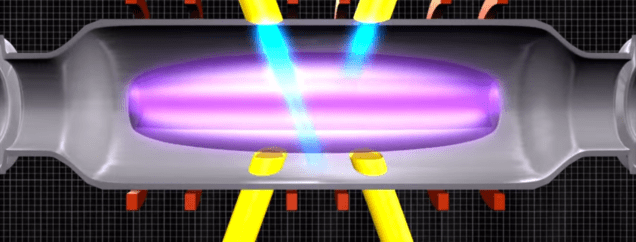 A small startup has announced a major advance toward fusion power, the Holy Grail of energy that could rid us of fossil fuels forever. Tri Alpha Energy says it’s built a machine that can hold a hot blob of plasma steady at 10 million degrees Celsius for five whole milliseconds.
Fusion power, the ever-science fictional energy source physicists have been chasing for decades, is premised on heating hydrogen atoms to temperatures hotter than the surface of the sun to produce a roiling mixture of electrons and ions known as plasma. When ions in a plasma collide, they sometimes form new atoms and release tremendous amounts of energy. (This is, in fact, the same type of reaction that powers the stars.) If only humans could figure out how to sustain a net-positive fusion reaction, we could kiss dirty carbon pollution goodbye.
If Tri Alpha’s claim is true, then the company has managed to hold a superheated ball of plasma steady for an incredibly long time, in fusion terms. What’s more, they’ve done so using a rather unusual reactor design — a long, cylindrical tube that collides pairs of plasma donuts to produce enormous amounts of heat. The resultant plasma blob is then stabilized with beams of high-energy particles, as explained in the video.
What’s next for Tri Alpha? A bigger, more powerful fusion tube that can reach even hotter temperatures and longer reaction times, hopefully. But let’s not get too excited just yet. Many well-funded government laboratories and private companies have been promising fusion for a long time, and this one — which mysteriously crops up in the news every now and again, despite not even having a website to its name — is shadowy to put it mildly. Also this month, a team of MIT researchers proposed a small, compact fusion reactor design,which they claim could be driving power to the grid within a decade.
One way or another, it seems we’re still years out from useful fusion. But hey, it it can’t hurt to start placing bets on which of these future energy outfits is going to announce a major breakthrough next.
Click link below to see video…
Source: A Startup With No Website Just Announced a Major Fusion Breakthrough
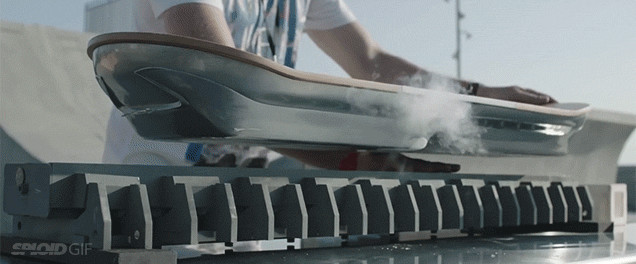 We were teased a hoverboard. We saw a hoverboard. And we even rode the hoverboard. So how does Lexus’ hoverboard actually work? This video breaks down the science behind it and like all things magical in science, it’s the lovely work of magnets. We can see how the polarity of the magnetic track is set up and how the board is made of superconductor blocks with a liquid nitrogen cooling system to achieve hover. Now let’s pave the entire world with magnets so we can ride this thing everywhere.
click link to watch video…
Source: The cool science behind how the Lexus hoverboard works

Aside from their abnormal growth rates, cancerous cells aren’t that much different from normal healthy tissue. That’s why radiation and chemo treatments can’t effectively target just tumors. However, a team of researchers from the Mayo Clinic believe they’ve discovered a mechanism that can rein in cancer’s uninhibited growth by retraining these wayward cells to die like they’re supposed to.
See, when cells get old and prepare to die, they’re supposed to stop dividing. This process is controlled by “biological processors” called microRNAs which feed the cell just enough of the PLEKHA7 protein to inhibit division. But in the case of cancer, the microRNAs don’t deliver enough of the protein and the cells begin to divide out of control, resulting in a tumor. In a recently published study in the journal Nature Cell Biology, the Mayo Clinic team found that by injecting microRNA directly into a tumor, PLEKHA7 levels returned to normal and the cancerous cells stop reproducing.
“This is an unexpected finding,” Chris Bakal, a specialist at the Institute for Cancer Research in London, told The Telegraph. “Normal cells touch each other and form junctions, then they shut down proliferation. If there is a way to turn that [process] back on, it would be a way to stop tumors from growing.”
What’s more, the method has shown to be surprisingly effective against some especially aggressive forms of cancer, at least in initial lab tests. However, the researchers don’t believe this will be some magic bullet that cures cancer outright. “This important study solves a long-standing biological mystery, but we mustn’t get ahead of ourselves,” Henry Scowcroft, Cancer Research UK’s senior science information manager, told The Telegraph. “There’s a long way to go before we know whether these findings, in cells grown in a laboratory, will help treat people with cancer. But it’s a significant step forward in understanding how certain cells in our body know when to grow, and when to stop. Understanding these key concepts is crucial to help continue the encouraging progress against cancer we’ve seen in recent years.” Still, any step forward in the fight against this disease will be a welcome one.
via Researchers may have found a cancer cell’s ‘off’ switch.

When movies break the fourth wall it’s always a little jarring. Like when you see someone you don’t know try to talk to you and you look behind your shoulder to see if it’s really you they want. But when characters express that awareness of being in their world to you, it can get pretty fun! For comedic purposes and dramatic purposes, it’s an interesting tool that filmmakers use.
Here’s Now You See It explaining how to break the fourth wall in movies.
In a perfect world—or at least in the perfect world I have in my mind—kids would learn about chemistry, history, or human evolution theory through claymation short films as cute and clever as this one. Actually, adults would learn like this too. Everything could use more claymation.
via Human evolution explained in a super cute two-minute claymation film.

In January Google announced that Ara, its highly anticipated modular smartphone, would debut first in Puerto Rico as part of a pilot project. Today, Google says it’s not launching Ara there after all, and that it’s “re-routing” its plans. What gives?
Some are wondering if the Google-Alphabet announcement is the reason for the shakeup, and that might very well be part of it. But what no one is talking about is the fact that Puerto Rico is in the midst of a catastrophic economic crisis—not to mention a drought so bad that the territory has implemented water rationing. It would be crazy to launch a tech project in Puerto Rico right now.
But let’s back up. At I/O earlier this year, Google’s Ara team said it was launching in Puerto Rico because of the diversity of users and existing phone market. About 77% of the country accesses the internet by smartphone only, which makes it a great place to test the Ara’s stripped-down browsing features.
Then the project went totally quiet—there were a few months without a peep. Although there’s no official statement from Google about the change in direction, the Project Ara team confirmed as much in a series of tweets today, including the fact that they might come back to Puerto Rico sometime later:
But this is probably a good move: It would be pointless and futile to test the product in Puerto Rico under some pretty dire circumstances.
First of all the US Territory is on the brink of economic collapse—it’s being called the “Greece of the Caribbean.” We’re talking defaulting on $72 billion in debts. If Google launches a phone project and suddenly the economy shut down, it would be particularly difficult to gauge success. And additionally—not that this is their primary concern—but it would reflect poorly on Ara.
Now, because people are so apprehensive about the economy, there’s currently a mass exodus from Puerto Rico, with other American cities bracing for the inevitable flood of immigrants. According to PBS, 150,000 Puerto Ricans are projected to leave in the next five years. So imagine you launch your test group and half of them end up leaving for the mainland. Not good.
Finally, Puerto Rico’s day-to-day infrastructure is in trouble. Stores are closed and food is prohibitively expensive. I mentioned water rationing before—now entire cities are having their water shut off for days at at time. I don’t mean they’re being told to cut back, I mean the municipal water is being turned off. People’s livelihood is at stake and helping to test a phone will likely be residents’ last priorities.
Project Ara may announce a different reason for why they’re launching elsewhere first, but let’s hope after all this they do indeed come back to Puerto Rico. Whatever happens next politically, I can only imagine this will not make life easy for the territory’s residents who have had to accept some pretty crippling austerity measures. They’ll probably be looking for more affordable and reliable options for accessing information. It would be a great place to showcase Google’s commitment to using technology to solve problems for all.
via Why Isn’t Google Launching Its Modular Ara Smartphone in Puerto Rico?.

Sometimes it feels like you spend tons of money on toys that your pup destroys in just a few days. Instead, use some old cotton shirts to make a fun braid toy for free.
Your dog will have just as good a time with this DIY toy, you won’t have to shell out any money, and you’ll get rid of a few old shirts (plus, if you have more shirts, you can make it again!). Here’s how to make it:
Cut nine 20inx2in strips and knot them together at one end.
Split the strips into threes and braid them together. You’re essentially creating three stronger strips for the braid by dividing the nine strips into threes.
Leave a little fabric unbraided at the end and tie another knot.
Now you’re ready to play tug-o’-war with your dog! Since this toy is made from old shirts, it is best suited for small or medium sized dogs (big ones will likely rip it apart quickly). If you have a ton of old shirts, you can make a pile of these to give to friends with dogs or to a local shelter (if they take toy donations).
Keep in mind that you need to pick toys best suited to your dog. If they tend to eat things they shouldn’t, this may not be a suitable toy for them. You don’t want them to end up eating any loose fabric and wind up taking them to the vet for a costly removal. Be extra careful and make sure to keep an eye on them so this doesn’t happen.






 It's my life, you're just along for the ride!